
General Information
The land of a thousand hills, with its endless expansive lush mountains and diverse natural beauty, lies within the Great Lakes region of Central Africa, and boasts a moderate climate. Mountains dominate the centre and west of the country, while the east consists of savanna, plains, and swamps.
Rwanda is bordered by Uganda to the north, Tanzania to the east, Burundi to the south, and the Democratic Republic of the Congo to the west. Despite being landlocked and one of Africa’s smallest countries (26,338km2), Rwanda has an incredible treasure trove of biodiversity that requires protection. The Albertine Rift Eco-zone (ARE), a region that stretches across six countries with Rwanda as its epicenter, is of particular importance as it has an exceptional level of species endemism. Scientists regard it as having the highest levels of biodiversity on the continent.
The nature love will be impressed by the variety and the parity of what can be observed visiting Rwanda, but there’s more to Rwanda than protected mountain gorillas and Albertine endemics. The shores of Lake Kivu boast some of the best inland beaches in Africa and offer an opportunity to explore the many small islands of Lake Kivu.
Kigali, the capital and conference hub of East Africa, forms a central stepping stone to various destinations within the country and Central and East Africa. The city is green, vibrant, safe, and brews superb homegrown tea and coffee. Although Rwanda is all too often associated with the 1994 Genocide that resulted in the mass murder of as much as 20% of the country’s total population, the country is taking giant strides towards cultural recovery and investment in the future.
National Flag and Seal
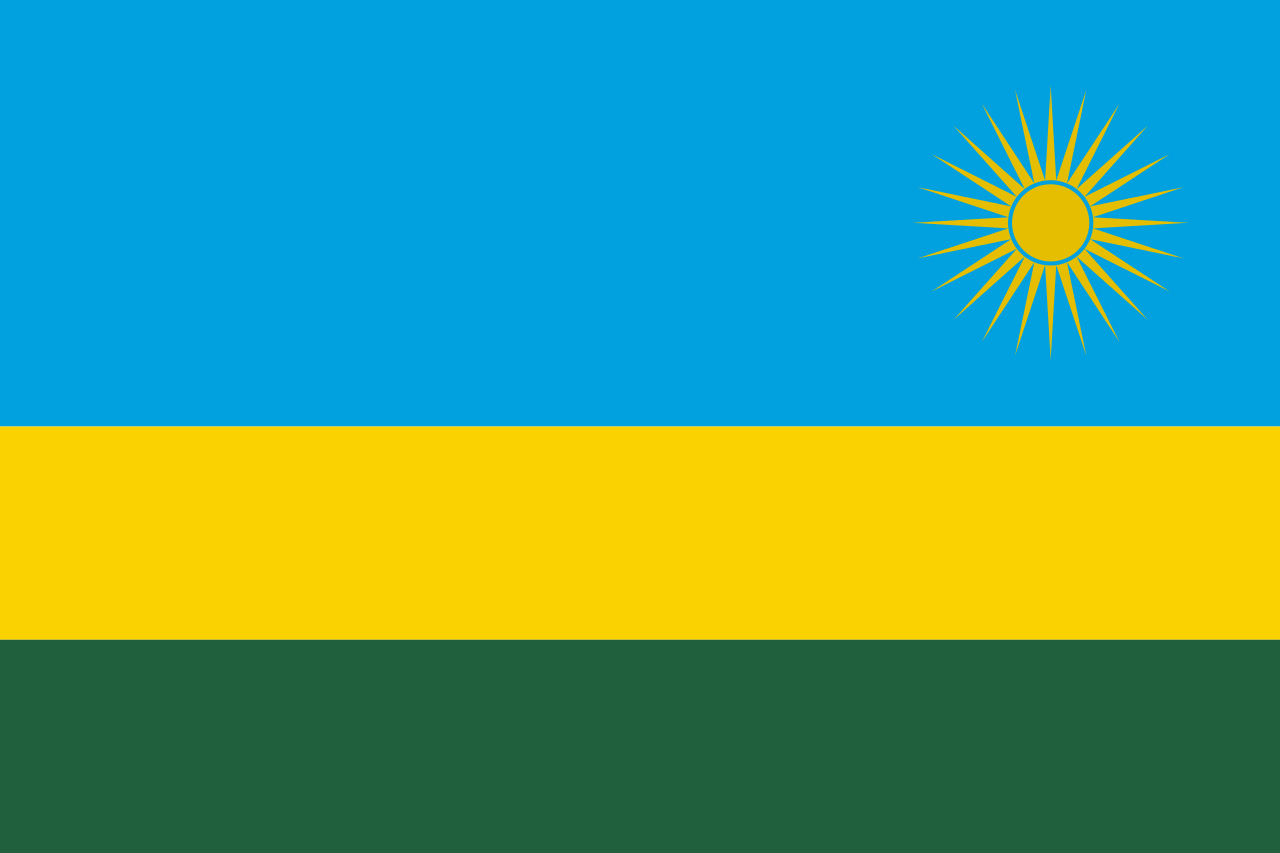
THE NATIONAL FLAG:The national flag comprises of the following colours from the bottom to the top: a green strip, followed by a yellow strip both of which cover half the flag. The upper half is blue and bears on its right hand side the image of the sun with its rays of golden yellow. The sun and its rays are separated by a blue ring. The characteristics, description, ceremonial and respect of the National Flag are determined by the law.
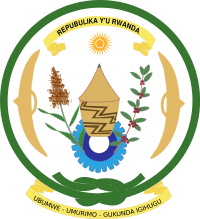
THE SEAL:The Seal of the Republic of Rwanda consists of a green ring with a knot of the same colour tied at the lower edge of the ring; on the top are the imprints “REPUBLIC OF RWANDA”. Below the knot is the national motto “UNITY, WORK, PATRIOTISM”. All imprints are written in black characters on a yellow background. It also consists of: the sun, its rays, sorghum and coffee, a small basket, a blue cogged wheel and one shield at the right hand side and another at the left hand side.
THE NATIONAL ANTHEM:The title of the national Anthem is “RWANDA NZIZA” [Beautiful Rwanda]. It consists of four (4) verses which generally praise the beauty of Rwanda as the common cradle of all Rwandan people and emphasises the unity of all Rwandan people. The Anthem also emphasizes the common characteristics of Rwandans and Rwandan values as their common heritage and the pillar of national development.

Economy
Currency: Rwandan Franc (RWF)
Fiscal Year: From July 1 to June 30
Trade Organizations: The East African Community (EAC), Common Market for Eastern and Southern Africa (COMESA), African Continental Free Trade Area, Everything but Arms agreement, AGOA free trade agreement, and World Trade Organisation (WTO)
GDP Growth: USD 9.1B
GDP per Capita: USD 787 (2018)
GDP per Sector: Agriculture: 29%, Industry: 16%, services: 48% (2018)
Credit Rating: B+ (S&P), B+ (Fitch)
Literacy Rate: 68%
Life Expectancy: 67 years (2018)
Unemployment: 14.5%
Main Industries: ICT, agricultural products, energy, mining
Time to Register a Business: 6 hours
Exports: US$ 702 Million (2018)
Export Goods: coffee, tea, hides, tin, ore
Main Export Partners: Switzerland, Democratic Republic of Congo, China, and Uganda
Imports: US$ 2,970 Million (2018)
Import Goods: cement, refined and non-refined palm oil and other cooking oils, sugar cane, animals, chemical fertilizers and clothing.
Main Import Partners: Uganda, China, Kenya, and EU
Sources: NISR, BNR, World Bank, Fitch, S&P (As of March, 2019)
Please click HERE to read the 'Invest in Remarkable Rwanda'.
History
For centuries, Rwanda existed as a centralized monarchy under a succession of Tutsi kings from one clan, who ruled through cattle chiefs, land chiefs and military chiefs. The king was supreme but the rest of the population, Bahutu, Batutsi and Batwa, lived in symbiotic harmony. In 1899, Rwanda became a German colony and, in 1919, the system of indirect rule continued with Rwanda as a mandate territory of the League of Nations, under Belgium.
From 1959, Batutsi were targeted, causing hundreds of thousands of deaths and sending almost two million of them into exile. The First Republic, under President Gregoire Kayibanda, and the second, under President Juvenal Habyarimana, institutionalized discrimination against Batutsi and subjected them to period massacres.
The Rwandese Alliance for National Unity (RANU) was formed in 1979 by Rwandan refugees in exile, to mobilize against divisive politics and genocide ideology, repeated massacres, statelessness and the lack of peaceful political exchange. In 1987, RANU became the Rwandese Patriotic Front (RPF). On 1 October 1990, the RPF launched an armed liberation struggle that ultimately ousted the dictatorship in 1994 and ended the genocide which cost more than one million lives – Batutsi and moderate Bahutu who opposed the genocidal regime.
After Kigali fell to RPA (RPF’s armed wing) on 4 July 1994, RPF formed a Government of National Unity headed by President Pasteur Bizimungu, bringing parties that did not participate in the genocide together. In 2000, Parliament voted out President Pasteur Bizimungu and RPF appointed then Vice-President and Minister of Defence, Major General Paul Kagame as the President of the Republic to lead the coalition government.
In 2003 President Paul Kagame was elected with landslide majority to serve a term of seven years. During those seven years, the country made unprecedented socio-economic and political progress and consolidated peace, stability as well as social cohesion among Rwandans. In 2010, President Paul Kagame was re-elected to serve a second term and on a platform of rapid development for the transformation of the lives of all Rwandans.

Culture
Rwanda has a rich culture, apparent in the diversity of crafts, dance, and strong traditions. Community projects throughout the country offer unique opportunities to meet local people in the traditional context while sharing experiences of cooking, fishing and even learning local crafts. There are several tea and coffee experiences to be had and numerous museums, memorials and historical sites to explore.
Imigongo Art
A popular art form, usually produced by women, using cow dung. The dung is dried and mixed with colors made from organic material, like plants, to create mostly black, white and red paints. This paint mixture is then applied on walls, pottery or canvas in spiral forms or geometric designs. Historically, Prince Kakira, the son of the King of Gisaka, living in the Province of Kibungo, known today as the Eastern Province, invented the art of decorating houses. Art is found throughout the country, but a visit to the local Kakira co-operative (named after Prince Kakira) is worthwhile to see artists at work. The local co-operative in the village of Nyakarimbi near Rusmo Falls border with Tanzania.
Agaseke Baskets
Traditionally the baskets are made from sisal and papyrus tree fibres, which are soaked in water for up to two weeks to soften them. They are then beaten with stones and left to dry before being woven. The natural fibres create the natural pale gold color which is decorated with the black patterns from boiling the roots and seeds of the Urukangi plant or banana flowers into a black dye. These days a number of dye colors and patterns are seen displaying the diverse creativity in the making of the baskets. In Rwanda tradition, these baskets served as containers to transport valued foods such as eggs, beans, meat, and other valuable objects. They were presented as wedding gifts to a bride and groom. After the 1994 genocide the smaller baskets have become symbols of peace, as Hutus, Tutsi, and Twa women sit side by side weaving the “peace baskets”.
Traditional Music and Dance
Music has always played an important role in the civil, economic and social life of Rwanda, and has a strong oral tradition of storytelling. All events in Rwanda are embellished with traditional songs and dance: weddings, birth celebrations, traditional baptism (guterekera), anniversaries, launching of new projects, political parties or the welcoming of important visitors. The 5/8 rhythm distinguishes, Rwandese music from other African music. While dancers dance, members of the chorus clap their hands to give rhythm and to cheer, encourage, and support the dancers.
Intore Dances
Dance is a collective and celebrated experience. The variety of music and dance demonstrate epicts acts commemorating excellence and bravery. Intore, which means the ‘Dance of Heroes’, or ‘The Chosen Ones’, was traditionally performed before the Royal Court by warriors who were celebrating their victory in battle. The men wearing long haired grass wigs and carrying spears dance rhythmically form side to side to the sound of ‘Ingoma’ drums. These celebratory dances include a drum orchestra of seven to nine members. Traditional sons, which often include humorous lyrics, are accompanied by a lulunga, an 8 stringed instrument. To see this spectacular traditional dance performed by the Intore dancers, be sure to visit the Ethonographic Museum in Huye

Tourism
Rwanda sits at the hub of Africa; here at the center of the Albertine Rift, where deep volcanic forces are pressing the continental plates apart, you will find a world of exquisite beauty as well as unsurpassed biodiversity. Once termed ‘earth’s most beautiful place’ by famous American humanitarian/author Rosamond Carr, and ‘One of the most incredibly beautiful places of the African continent’ by ‘www.mapsofworld.com’.
Rwanda is also Famously known as ‘The Land of a Thousand Hills’ due to its mountainous and irregular terrain, Rwanda offers breathtaking natural surroundings and as unique flora and fauna in its various national parks.
Rwanda is the bridge between the forest ecosystems of the Congo basin along with the great rift valleys of the east. It shares in the biological riches of both worlds, offering a concentration of biodiversity found nowhere else in Africa. The country’s natural assets include six volcanoes, twenty-three lakes and numerous rivers. The spectacular volcanoes and dense tropical forests dominate the north of the country, while there are hills and valleys, lakes and rivers, and savannah as well as tropical vegetation in the rest of the country.
The Park National des Volcanoes in northern Rwanda is home to the world’s largest number of endangered mountain gorillas, who live in a protected area and can be viewed in their natural habitats at a fairly close range.
670 different bird species have been recorded in Rwanda, as have 100 orchid species in the Nyungwe Forest National Park. Akagera National Park is a savannah park with typical wildlife-lions, giraffe, elephant, hippopotamus, hyena, impala and gazelle.
There are also water bodies ideal for water sports and fishing particularly Lake Kivu in the west and Lake Muhazi in the east. Lake Kivu also offers beautiful beaches, jutting peninsulas and islands.
Other tourism products include canopy swings in Nyungwe National Park, Cave Tourism, New city tours in Huye and Rubavu, Mountain biking that offers riders just the perfect terrain to be enjoyed, Fishing in Lake Kivu, and Trekking which includes mountain Gorilla trekking that gives tourists the opportunity to observe the gorillas from a very close distance, see them rest, sleep and feed.
Please click HERE to read the 'Rwanda Visitor Guide'.

Rwanda Coffee
Coffee plays a major role in the economy of the country, contributing significantly to foreign exchange earnings and to the monetization of the rural economy. Currently, ca. 400,000 small holder farm families produce it and depend on it for their livelihoods.
Coffee was introduced by Germans in early 1900s, it is dominated by mainly ‘bourbon’ type of Arabica coffees.
The production ranges from 267,000 to 420,000 bags per year (16,000MT to 210,000MT). The total area in coffee is currently 42,000 hectares grown and it is grown in most provinces in the country at an altitude less than 1,900m.
The Coffee sub-sector is coordinated under the National Agricultural Export Development Board (NAEB).

Rwanda Tea
Tea is one of Rwanda’s major exports commodities which generated USD 86.9 million exports revenues in 2019.
Tea was introduced in Rwanda in the 1950s.
Currently there are more than 24,000 hectares planted with tea in the Northern, Western and Southern provinces on hillsides and well drained marshes at high altitude between 1,550 m and 2,500 m.
There are 18 privately owned operational tea factories, 2 ongoing tea project, more than 43000 tea farmers organized in 21 cooperatives and 2 out growers’ services companies. Tea expansion is ongoing and area planted with will keep increasing as well as construction of more factories.
Production has increased steadily over the years from 5,910 tons of black tea in 1980, to 12,855 tons in 1990. In 1994, during the genocide, tea plantations and factories were abandoned and tea production decreased to 4,136 tons of black tea.
From 1994, a lot of efforts were made to rehabilitate tea industry and tea production increased to 14,391 tons in 2000; 22,249 tons in 2010 and 32,127 tons in 2019. Black CTC tea is the predominantly type of tea produced in Rwanda, but other types like Orthodox tea, Green Tea and White tea are also produced. Organic tea is also found in Rwanda and value addition is made at small level.
The Tea sub-sector is coordinated under the National Agricultural Export Development Board (NAEB).